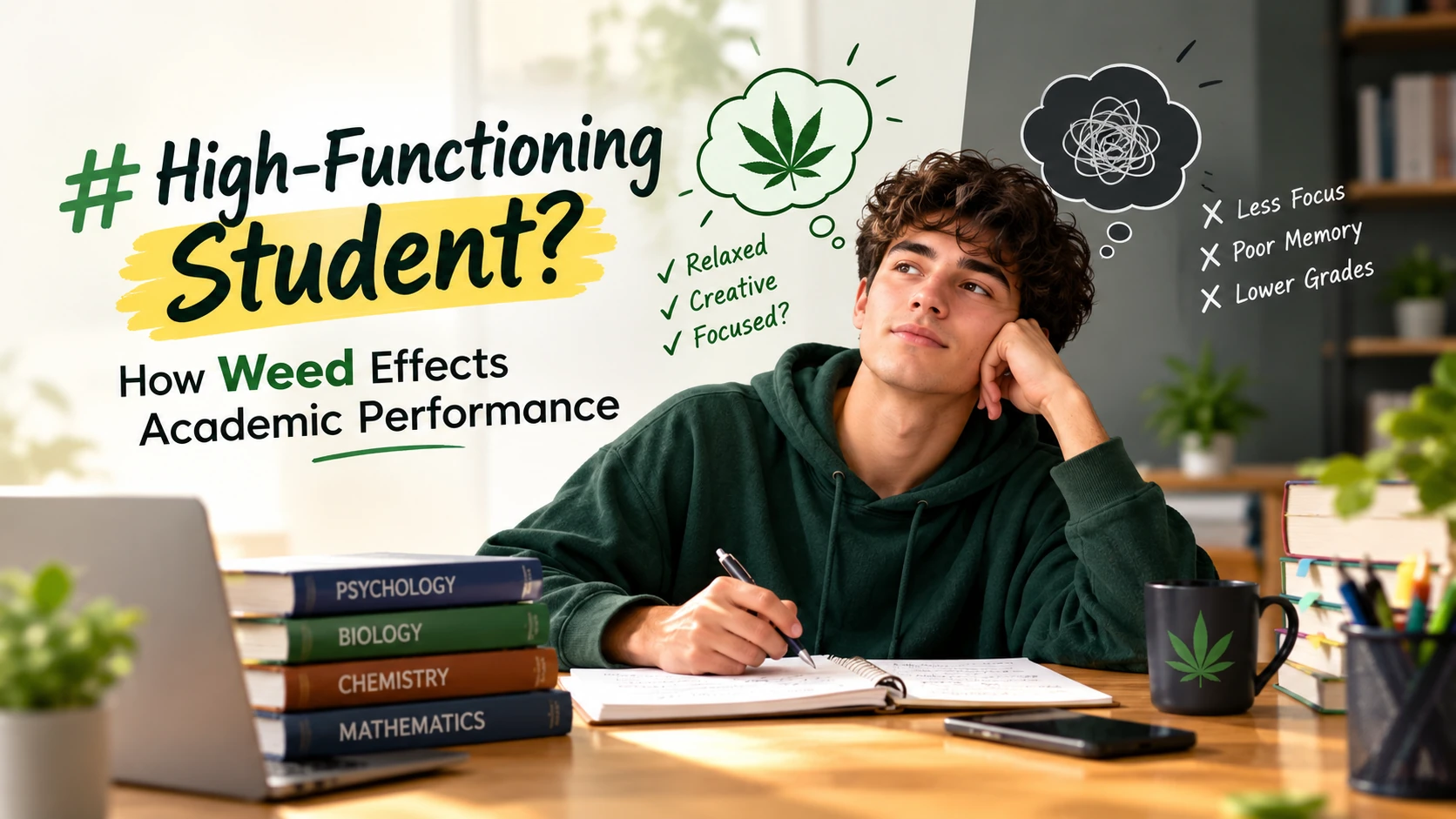
The image of the lazy, unproductive stoner is rapidly fading in 2026. As campus policies shift and legalization becomes the norm across many regions, a new demographic has emerged: the academic stoner. These are students who maintain high grades while incorporating cannabis into their daily or weekly routines. However, beneath the surface of the high functioning lifestyle, the question remains: how weed effects student life over the long term.
Understanding this impact requires looking past stereotypes. Whether you are using it to manage stress, improve sleep, or simply socialize, THC interacts with the developing brain in ways that can either be a minor hurdle or a major roadblock to your degree. This guide explores the nuance of cannabis use in university settings, backed by current research and student experiences.
Short Term Cognitive Hits: What Happens During a Lecture?
The most immediate way weed effects student life is through cognitive interference. When you attend a lecture or try to study while under the influence, or even during the ‘fog’ of the following morning, your brain’s processing speed takes a hit.
Memory Encoding and Retrieval
Cannabis primarily impacts short term memory. For a student, this means the ability to take in new information during a complex chemistry or law lecture is compromised. You might feel like you are following the logic in the moment, but the transfer of that data into long term memory storage often fails. This leads to the frustrating ‘tip of the tongue’ syndrome during exams where you know you studied the material but cannot quite reach it.
Attention Span and Focus
While some students claim that specific strains help them ‘zone in’ on repetitive tasks, research generally shows that THC causes fragmented thought patterns. This makes multi-tasking or following multi-step instructions significantly harder. If your coursework involves heavy data analysis or intricate problem solving, the cognitive load added by cannabis can lead to careless errors that tank your grades.
The GPA Gap: Does Frequent Use Lower Grades?
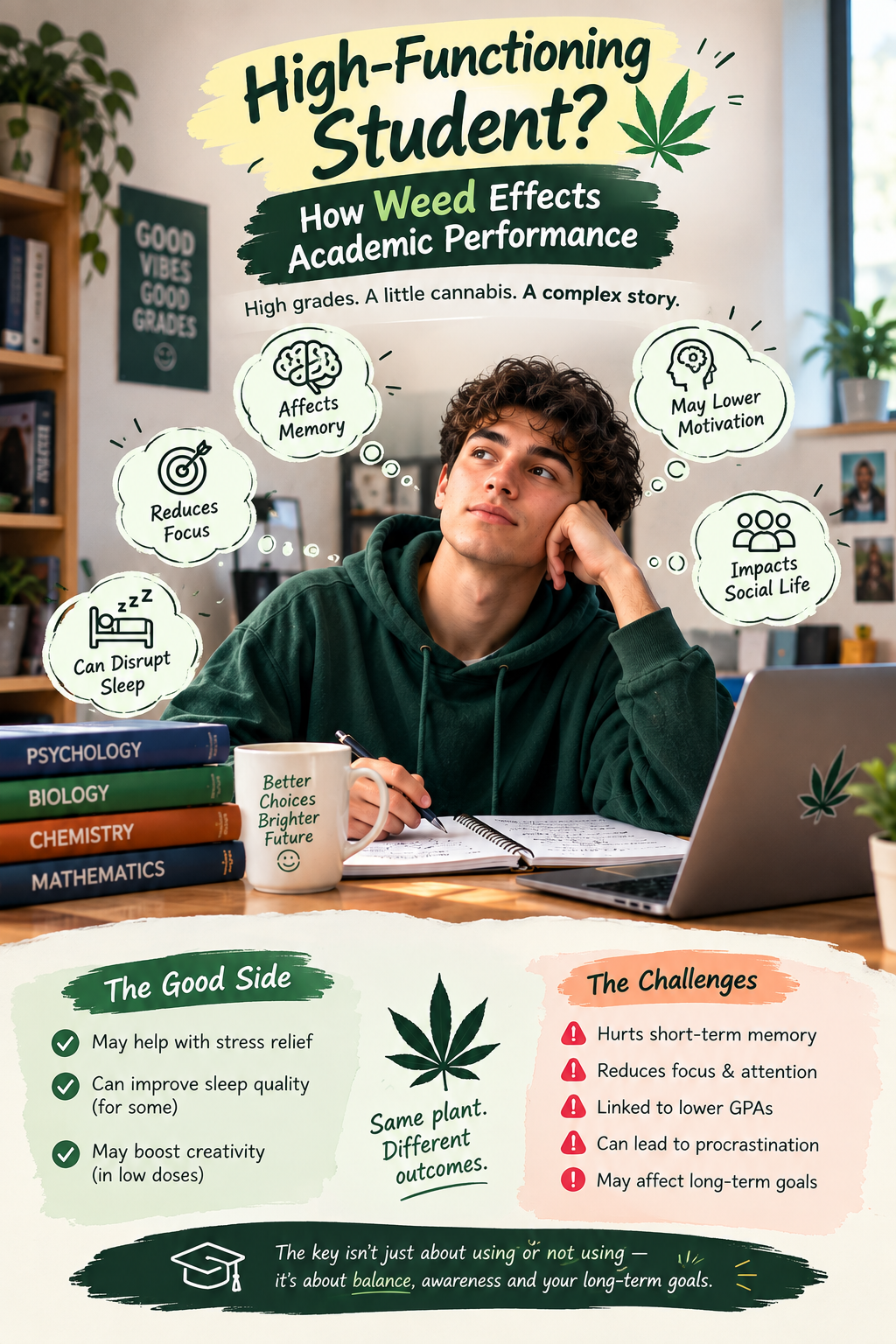
Statistical trends in 2026 continue to show a correlation between heavy cannabis use and lower overall GPAs. However, the ‘why’ is more complex than just being ‘high.’
Students who use cannabis daily are more likely to skip morning classes. Missing just 10 percent of lectures has a direct mathematical impact on final grades. Furthermore, the habit of ‘procrastination via pot’ is a real phenomenon. Instead of tackling a difficult essay, a student might choose to smoke to relieve the stress of the essay, which lead to further delays and a lower quality of work produced in a rush.
It is not just about the grades themselves. Frequent use is often linked to a higher rate of ‘stopping out,’ where students take unplanned breaks from their education or take longer than four years to complete a standard degree. This has massive financial implications, especially regarding the loss of scholarships that require a specific credit load or GPA maintenance.
Amotivational Syndrome: Myth or Academic Reality?
One of the most debated topics is amotivational syndrome. This is described as a state of passivity and a lack of interest in long term goals. In a student context, this does not always look like sitting on a couch all day. It often manifests as a ‘settling’ for mediocrity.
Instead of pushing for an internship or joining a pre-professional club, a student might feel content just doing the bare minimum to pass. The dopamine reward system in the brain is recalibrated by regular THC use. When the brain receives a dopamine hit from cannabis, the natural ‘high’ of achieving an A on a paper or finishing a project feels less rewarding. Over time, this can dull the competitive edge needed in rigorous academic environments.
Social Life and the Green Bubble
How weed effects student life extends far beyond the classroom. Socially, cannabis can be a double edged sword. For students with social anxiety, it may act as a social lubricant in small groups. However, it can also lead to what sociologists call the ‘green bubble.’
This occurs when a student’s entire social circle revolves around cannabis use. While these friendships feel deep in the moment, they can become limiting. If every social interaction requires being high, the student misses out on diverse networking opportunities, sports, or clubs that require full sobriety and engagement. This isolation can become particularly problematic during senior year when networking for jobs becomes a full time social necessity.
High Functioning vs. Struggling: A Comparison Table
Not every student reacts to cannabis in the same way. Below is a comparison of how different usage patterns typically manifest in a university setting.
| Aspect | High Functioning User | Struggling User |
|---|---|---|
| Attendance | Rarely misses class: uses only on weekends or after work is done. | Frequently misses 8 AM or 9 AM lectures due to ‘weed hangovers.’ |
| Deadline Management | Uses tasks as a reward for finishing assignments. | Uses cannabis to avoid the stress of upcoming deadlines. |
| Memory | Experiences minor brain fog but utilizes robust note taking. | Struggles to recall basic concepts during midterms. |
| Social Integration | Has a diverse group of friends, both users and non-users. | Social circle is exclusively limited to other heavy users. |
| Goal Orientation | Actively seeks internships and career growth. | Lacks interest in extracurriculars or future planning. |
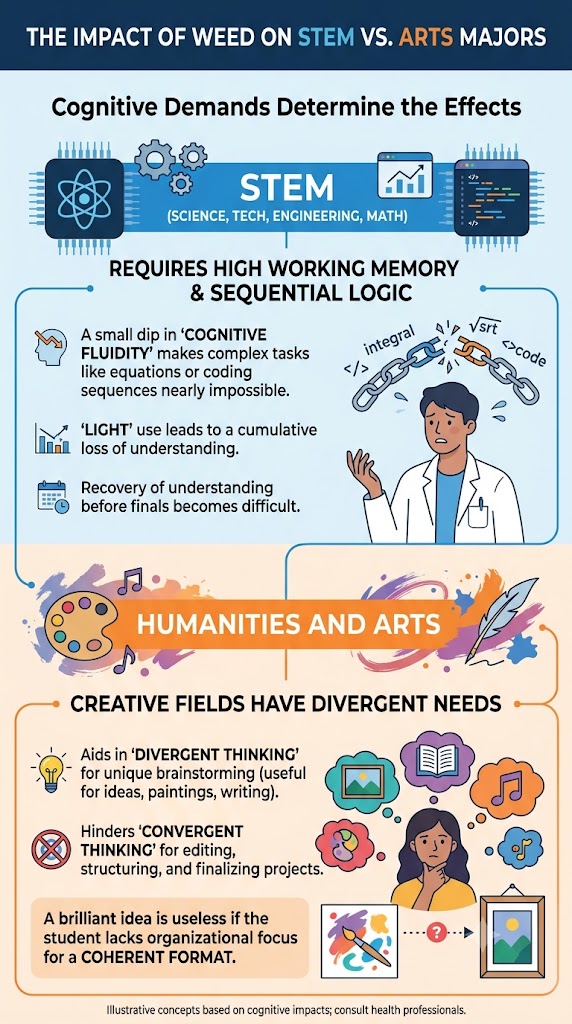
The Impact on STEM vs. Arts Majors
The effects of weed can vary depending on the ‘cognitive demands’ of a specific major.
STEM (Science, Tech, Engineering, Math)
These majors require high levels of working memory and sequential logic. A small dip in cognitive fluidity can make a physics equation or a coding sequence impossible to complete. STEM students often report that even ‘light’ use during the week leads to a cumulative loss of understanding that is hard to recover before finals.
Humanities and Arts
Students in creative fields often claim that cannabis aids in ‘divergent thinking,’ which is the ability to come up with unique ideas. While this may help in the brainstorming phase of a painting or a creative writing piece, it often hinders ‘convergent thinking,’ which is the ability to edit, structure, and finalize a project. A brilliant idea is useless if the student lacks the organizational focus to put it into a coherent format.
Strategies for Harm Reduction and Academic Focus
If you choose to use cannabis while in school, there are ways to mitigate the negative impact on your student life.
- The ‘Work First’ Rule: Never use cannabis before you have completed your academic goals for the day. Treat it as a reward, not a prerequisite for existence.
- T-Breaks During Finals: Tolerance breaks are essential. Clearing your system two weeks before final exams can help restore cognitive clarity and memory functions when they matter most.
- Monitor the ‘Morning After’: Pay attention to how you feel the day after use. If you are groggy and reaching for a third cup of coffee just to sit through a lecture, your usage frequency is likely too high.
- Avoid High Potency Concentrates: Dabs and high THC waxes have a much more profound impact on brain chemistry than traditional flower. For a student, the recovery time from these concentrates is significantly longer.
- Check Financial Aid Rules: In 2026, many private scholarships still have strict drug free clauses. Being caught with cannabis on a dry campus can lead to a loss of funding that ends your college career regardless of your GPA.
Ultimately, how weed effects student life is a matter of individual chemistry and discipline. For some, it is a manageable part of their downtime. For others, it becomes a silent thief of potential, slowly eroding the focus and motivation required to succeed in a competitive world.
College is a unique time where your brain is still finalizing its frontal lobe development, the area responsible for decision making and long term planning. Overloading this process with THC can have consequences that last far beyond graduation. By staying mindful of your habits and prioritizing your academic goals, you can ensure that your student life remains productive, social, and successful.
FAQs
Does smoking weed make you lose your memory?
It primarily affects short term and working memory. While it does not necessarily ‘erase’ old memories, it makes it much harder to create new ones and retrieve specific information under pressure.
Can I still get a 4.0 GPA if I smoke weed?
Yes, it is possible, but it requires extreme discipline. High achieving students who use weed typically do so very sparingly and never allow it to interfere with their study or sleep schedules.
How long does weed stay in your system for a student drug test?
For a casual user, it may be out in 3 to 5 days. For a daily user, THC metabolites can be detected in urine for 30 days or longer. Hair tests can detect use for up to 90 days.
Does cannabis help with college anxiety?
It may provide temporary relief, but chronic use is often linked to ‘rebound anxiety.’ When the effects wear off, the original stressor (like a looming exam) is still there, often feeling more overwhelming than before.
Will weed affect my financial aid?
While federal laws have shifted, many specific scholarships and university housing contracts have ‘zero tolerance’ policies. A disciplinary record involving cannabis can lead to the revocation of these benefits.

1 thought on “High-Functioning Student? How Weed Effects Academic Performance”