
Does the world really need another three hours of Elizabeth Holmes? That is the question looming over You Can See Everything, the massive 174-minute documentary from A24. Released in October 2026, this collaboration between Nathan Fielder and director Lance Oppenheim is not your standard true crime procedural. Instead, it is a claustrophobic, often hilarious, and deeply unsettling look at the 34 days leading up to Holmes entering federal prison.
While the runtime might seem daunting, the film manages to justify its length by pivoting away from the well worn history of Theranos. Rather than retreading the trial, it focuses on the psychological warfare between Fielder, a master of social discomfort, and Holmes, a woman whose entire life has been built on a foundation of curated reality.
The 174-Minute Elephant in the Room
Critics and audiences alike have voiced concerns regarding the nearly three-hour length. However, the pacing of the film, edited to reflect the slow, agonizing crawl of time for someone awaiting a prison sentence, is intentional. Fielder and Oppenheim use the time to let the subjects drop their guard. By the second hour, the performative nature of the Holmes household begins to crack, revealing something far more complex than the robotic persona seen in media interviews.
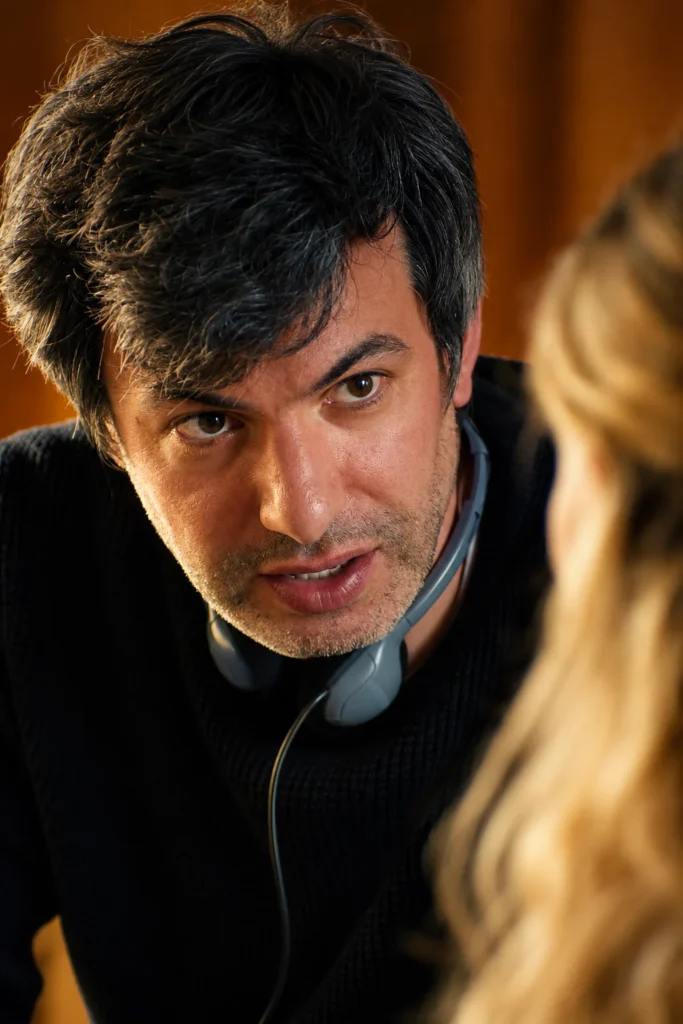
Nathan Fielder vs. Elizabeth Holmes: A Battle of Manipulators
One of the most fascinating aspects revealed early in the film is that Elizabeth Holmes had no idea who Nathan Fielder was. Before filming began, she reportedly had to watch clips of Nathan For You on YouTube to understand his brand of comedy. This creates an incredible power dynamic. Fielder, known for tricking small business owners into absurd schemes, finds himself face to face with a woman who convinced the world she could revolutionize medicine with a drop of blood.
Fielder is self-aware about this. He notes in the film that it is ironic for a man who built a career on business scams to be documenting the ultimate business scammer. Yet, Holmes seems to miss the joke entirely. Her inability to process Fielder’s irony becomes a central theme, highlighting a profound logical disconnect in her worldview.
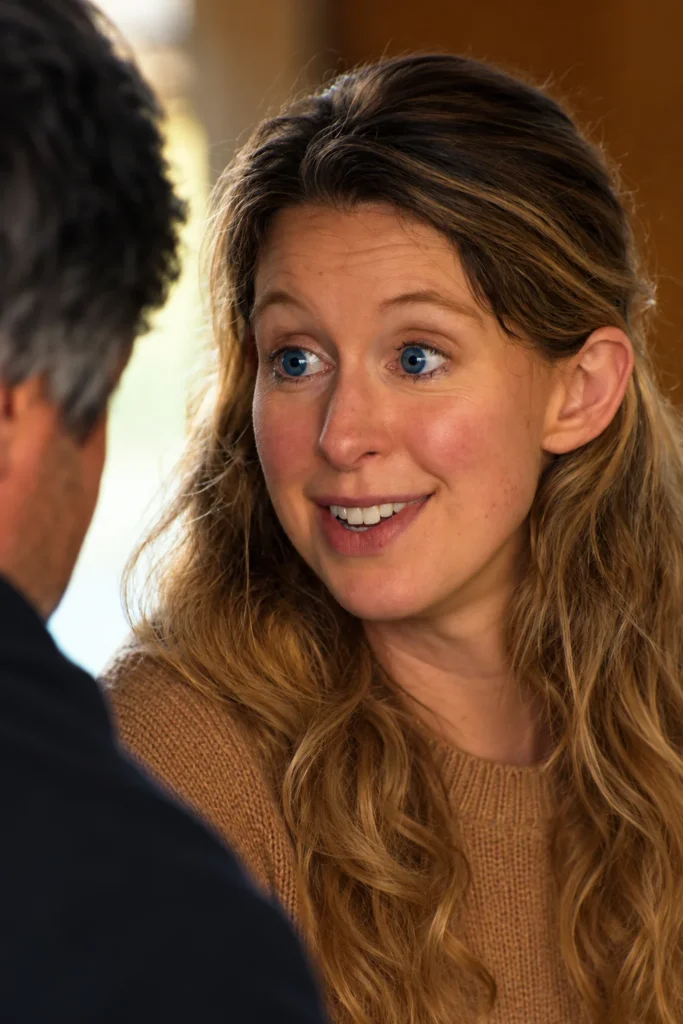
The Billy Evans Factor: More Than a Supporting Role
While Holmes is the star, her partner Billy Evans often steals the spotlight in the most jarring ways. Evans, a luxury resort heir, is portrayed as a quasi-Hitchcockian figure. The film includes a controversial and highly discussed scene involving Evans in the shower, which some critics have compared to the voyeurism of Psycho.
Evans is not just a supportive bystander. He is shown to be a controlling influence who speaks for Elizabeth, often translating her literalist thoughts into something more palatable for the cameras. His voice, which many viewers have noted sounds eerily similar to Fielder’s own monotone, adds a layer of uncanny valley to the entire production.
Who’s on First? The Deconstruction of a Fraudulent Mind
Perhaps the most significant sequence in the documentary involves the classic Abbott and Costello routine, Who’s on First?. Fielder plays the skit for Holmes to illustrate the nature of miscommunication and semantic confusion.

| Character | Reaction to the Skit | Significance |
|---|---|---|
| Elizabeth Holmes | Confusion / Literal interpretation | Suggests a fundamental inability to grasp wordplay or subtext. |
| Billy Evans | Intellectual dismissal | Frames Elizabeth’s lack of understanding as a sign of her “different” mind. |
| Nathan Fielder | Analytical / Frustrated | Uses the skit to bridge the gap between his comedy and her history. |
Holmes’ inability to find the humor in the skit serves as a metaphor for her defense during the Theranos trials. She treats the English language as a series of technicalities rather than a tool for shared truth.
Theranos 2.0: Delusion or a New Deception?
One of the most shocking revelations in the film is that Holmes and Evans appear to be working on a successor to the Edison device. Labeled by some as Theranos 2.0, the documentary captures them developing new medical equipment in their San Diego beach house. Holmes maintains that the original Edison was not a failure of science, but a failure of the world to wait for the science to catch up. The film raises serious questions about whether she has learned anything from her conviction or if she is simply preparing her next act.

Cinematography and Visual Language
Cinematographer David Bolen utilizes long lenses and slow zooms to create a feeling of constant surveillance. Much of the footage feels like it was captured through cracks in doors or across the expansive Del Mar property. This voyeuristic style reinforces the title: you can see everything, yet you feel as though you shouldn’t be looking. The visual language transforms the home into a gilded cage, making the eventual transition to a prison cell feel like an inevitable conclusion rather than a sudden shock.
Also Read : Namita Krishnamurthy: The Full Biography of the IIT-Grad Star
Frequently Asked Questions
Q.How long is the documentary You Can See Everything?
The film has a runtime of 174 minutes, nearly three hours in total.
Q.Did Elizabeth Holmes know Nathan Fielder before the movie?
No, she reportedly had to watch his YouTube clips to understand who he was before filming began.
Q.Where can I watch You Can See Everything?
The film is an A24 production and is expected to hit streaming platforms following its limited theatrical run in late 2026.
Q.Is Billy Evans in the movie?
Yes, Billy Evans plays a significant role in the documentary, which explores his relationship with Holmes and his involvement in her life.